“Think of web experiences that are not just visually stunning but also smart and responsive”
WebGL it is like a bridge connecting the raw power of a computer's graphics processing with the interactive nature of web content
 Amsterdam. December 13th, 2023
Based in Amsterdam, Niccolò Miranda is a multidisciplinary freelancer, creating iconic digital experiences. He is originally from Italy and found his vocation after designing the website of a friend’s restaurant. Now, he works as an art director, designer and developer for brands from around the world, such as Prada and Gucci.
In an interview with TIA, he described the important elements to consider when building a brand as a freelancer and explained the main principles behind WebGL and its significant. He also gave examples of recent projects he has been involved in and gave recommendations on how to work with clients to improve the process.
To kick things off, what “non touristy” places would you recommend visiting in Amsterdam?
NDSM, Amsterdamse Bos, SkateCafe, Nieuwe Diep Distillery.
How has the unique cultural and creative vibe of Amsterdam influenced your work and creative pursuits?
Amsterdam has given me emotions that are beyond words. It’s like an alternate reality crafted for creative minds. Here, you can relish experiences and feel a sense of freedom that’s unparalleled. While Amsterdam has its pros and cons, I believe it’s incomparable to any other European city. Over the past three years, I’ve met designers, digital thinkers, attended conferences, laughed, worked tirelessly, and most importantly, lived fully. It’s an ideal place for someone in their 30s, offering a space to live, grow, and feel truly alive.
For those who aren’t familiar with your career, can you provide an overview?
Hard to find a formula, but I can express my capabilities as Art Director, Designer and Developer. After I got a degree in Computer Science, my professors encouraged me to continue my studies, but I felt a need for change. I was searching for a vocation that married my passion for visual arts with my affinity for technology.
It was the year 2016, the epicenter of one of the strongest earthquake in the history of Italy hit my University city (Camerino). The bachelor was re-scheduled for security reasons. Unknowingly, I forced myself to find a vocation, something I was good at it pursuing passion for visual arts and nerdy terminal commands. A friend of Giulia (my partner in crime) commissioned me to build his brand-new restaurant website.
This project became a turning point. It wasn’t just about developing a website; it was about integrating my skills in photography and video editing to create a cohesive and impactful brand direction. Since then, my career has been a journey of discovery and growth. Like Matthew McConaughey, I’m continually seeking my ‘hero’ in the realms of Creative Direction, Design, and Development. In the last 7+ years, I had the incredible opportunity to collaborate with top-tier agencies and name such as: Prada, Gucci, Bill Gates, Roger Federer and I feel so grateful for this (portfolio websites). I’ve realized that my love for this industry is so vast that I am constantly driven to explore and learn about its various facets.
What is a typical working day for you?
My mornings start at a comfortable pace; I’m not particularly an early riser, but I ensure I have ample time to gear up for the day. One of my daily pleasures is varying my breakfast, often opting for scrambled eggs and avocados. Instead of morning coffee, I prefer smoothies, sometimes with a hint of Reishi mushroom (the non-magical kind, of course!).
My days are a blend of client meetings, exploratory work, mentoring students, learning new things, creating, and publishing. This routine is my everyday mantra. The world, especially with the burgeoning field of AI, feels brimming with discoveries, and I find myself constantly eager to delve into more.
When it comes to building your personal brand as a freelancer, what are some key factors to consider?
Commitment, passion, love are keys.
But a formula for excellence that I have found useful in recent years for my professional growth is based on this chart I presented in the Awwwards 2022 Conference in Amsterdam. We have seen how knowledge of different visual arts can increase the outcome of a product extensively, how experience can help solve problems, and how communication plays an essential factor in organizing ideas and sharing them with the team.
And if those succeed, the Aha! Moment is placed at the middle.

What defines a “visual developer,” and how does this role bridge the gap between design and development in modern web projects?
Visual Development is the definition for the perfect hub that promotes a balanced cross-disciplinary between designer and developer (I recently talk about my “Visual Developer” journey on the Awwwards Coffee Break, side episode of the my new Masterclass “Building Interactive Website: from Design to Development”).
I still do believe after a few years that high-level coding is a tangible part of digital creative capabilities (WebGL, Three.js, Vue.js, Nuxt.js, Webflow), I’ve realized that it’s not always necessary to code, but rather to understand how coding works. This understanding empowers one to experiment and broaden their design thinking on a daily basis. It’s an essential perspective that all digital thinkers, whether designers, founders, or creative directors, should grasp.
WebGL has revolutionized the world of interactive web graphics. Can you explain the fundamental principles behind WebGL and its significance in web development?
WebGL, at its core, is a JavaScript API that empowers web browsers to render interactive 3D and 2D graphics without requiring any plugins. It is like a bridge connecting the raw power of a computer’s graphics processing with the interactive nature of web content. Imagine being able to interact with 3D models, manipulate complex data visualizations, or play graphics-intensive games directly in your browser – that’s the magic of WebGL.
In the recent years, I pushed myself to use WebGL where possibile, it’s about breaking barriers (WebGL projects). It allows us to build applications that are not only visually stunning but also accessible across a wide range of devices and platforms.
What exciting developments or trends in the realm of WebGL are you currently following, and how do you anticipate they will impact the web’s visual landscape?
I’m closely watching the synergy of WebGL with AI, VR, and XR. These technologies are transforming the web from a flat space to an immersive, interactive 3D environment. Think of web experiences that are not just visually stunning but also smart and responsive. The trend towards spatial computing and gamification is particularly exciting, hinting at a future where web interactions are as engaging as video games.
Also noteworthy is Spline’s integration with Webflow, making sophisticated 3D web design more accessible and have built-in 3D models in a WebGL environment way faster.
Interesting Fact: WebGL seems to be just the starting point. With WebGPU on the horizon, offering more power and versatility, we’re looking at a new era of digital creativity. This evolution is set to redefine the web’s visual landscape, making it richer and more dynamic.
Creative coding can lead to unexpected and visually stunning outcomes. Can you describe a project where the final result surprised even you, the creator?
In recent times, I’ve found it challenging to be genuinely surprised by innovative web experiences. However, my collaboration with Breakthrough Energy, founded by Bill Gates, rekindled my appreciation for pushing the boundaries of what’s possible using WebGL.
Working alongside G-NS Studio, we initiated the 3D Visual Art Direction for Breakthrough Energy’s ‘The State of the Transition’ Annual Report 2023. The concept was to create a visual representation that embodied the balance between smart energy solutions and the natural world, reflecting the core mission of Breakthrough Energy.
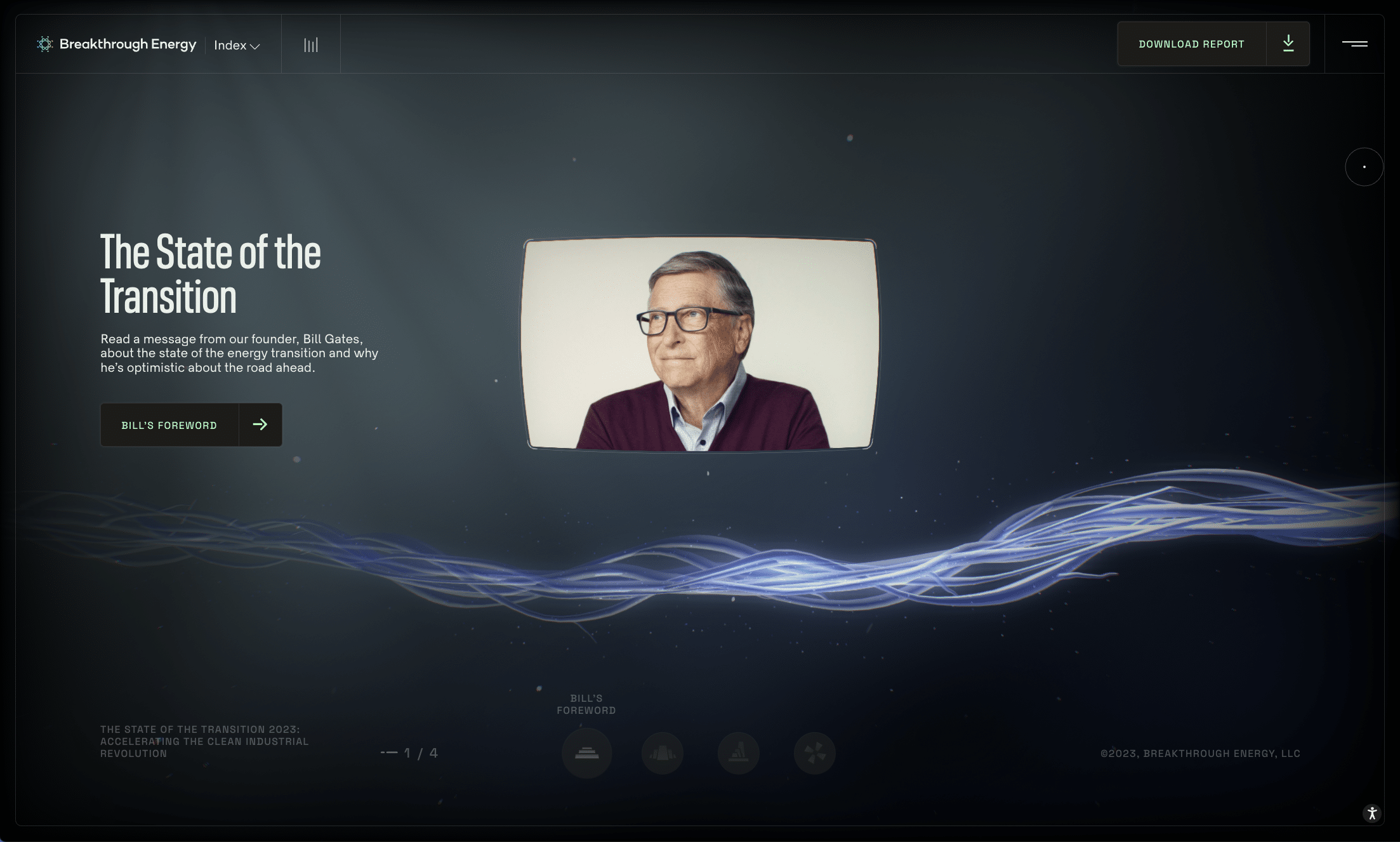
We conceived a design where WebGL-rendered roots symbolize the connection between advanced energy technologies and the earth’s wellbeing. These roots, pulsating and growing, formed an interactive gateway to various sections of the report, including Bill Gates’ Foreword, the 5 Grand Challenges, Our Programs, and Carbon Management.
Initially, we developed the visual concept using Midjourney. Then, we transitioned to WebGL to bring this concept to life in a web-based 3D scene. To enhance performance across different devices and streamline the usual process of exporting models in GLTF/OBJ formats, we chose an innovative approach. We utilized generative WebGL shaders, expertly developed by Edu Prats, foregoing the traditional method of baking textures onto the model.
The project was an iterative process, with approximately a month of refining and perfecting the visuals. The final result was astounding, surpassing our expectations and truly showcasing the potential of creative coding using generative WebGL.
Which types of clients do you find especially interesting?
When considering client types, I find those with a clear creative vision particularly intriguing. They bring inspiring ideas to the table and are open to exploring new possibilities, which makes the design and development process more dynamic and fulfilling. Equally important are clients who value organization and effective communication. They understand the importance of clear guidelines and feedback, ensuring the project runs smoothly without unnecessary overreach.
What recommendations would you give to clients to help streamline the process between their vision and your process?
To streamline the process between a client’s vision and design process, I want to emphasize the importance of clear communication and thorough documentation. It’s crucial for clients to articulate their vision as precisely as possible. Providing detailed briefs, examples, and any relevant materials upfront can significantly aid in aligning our understandings and expectations. I encourage clients to be actively involved in the initial stages, especially during the establishment of key design elements and the exploration of different creative directions. This involvement ensures that their vision is not only heard but also actively shapes the project’s trajectory.
Are there any emerging technologies or trends that you believe have the potential to disrupt the design industry in a significant way?
As we journey deeper into the realm of AI, we recently saw the potential of having a day-to-day assistant can helps you in design creation, project briefs, development. We shoudln’t consider AI as a thread, but a as tool to expand our consciusness, knowledge and experience.
Note: I recently came across a new technology called Gaussian Splatting, I do believe it has the power to be a game-changer in the 3D space within the new few years.
Three top tools you can’t live without?
Figma, ChatGPT, Notion.
What are your favorite ways to decompress outside of work?
I may not be a pro athlete, but I love to mix things up like the stairs in Harry Potter. I love to kick-box here in Amsterdam, skateboarding is my jam, love kayaking and have a beach volley with friends on summer times. Outside workout, I do like have drinks with friends, play games on PlayStation and just have fun how I can.
From your personal standpoint, what is the greatest challenge of our time?
In the realm of digital design and technology, AI stands as the next big leap. Yet, the pressing challenge remains: “How do we harness its monumental capabilities? How can we shape AI to ensure our digital world remains deeply human-centric and driven by genuine creativity?
This is our big challenge as mankind. It’s imperative to protect user data, ensure its confidentiality, and use it ethically. This is not something we can take for granted. Even if AI can incredibly helps us all, we must regulate it.
Can you name a fun-fact people would be surprised to learn about you?
It might be a surprise for who know me personally, but I am deeply passionate cook lover. I practically cook every day during my lunch break, it’s my form of meditation. My go-to dish? ‘Cacio & Pepe’ without any doubts. It’s my workhorse, it never fails to soothe my soul and make me feel like a chef extraordinaire.
Niccolò’s Working Preferences:
Early Bird or Night Owl?:
Night Owl
Food you can’t live without:
Pasta
Most quoted book, TV Show or movie:
Interstellar
Next travel destiny in your list:
The World
Favourite music genre or band:
Indie Electronic
Favorite design tool:
Figma
Preferred spot in your town:
Vondelpark, Amsterdam
Favorite video games:
Horizon: Forbidden West
Unusual Hobbies:
Props Collector
What is something on your bucket list that you haven't done yet?:
Found my own studio
Thanks Niccolò!
- Follow Niccolò on social media:
Agency to watch

Best in Breed since 1998. Lounge Lizard is a Digital Agency that Specializes in Brand Strategy, Website Design, Web Development, Mobile APP Development, Online Marketing, Social Media, Ecommerce, and SEOdigital experiences that move brands and businesses from now to next.
Featured agencies

134751 Views

115347 Views

109198 Views

91626 Views

88082 Views

82922 Views

74555 Views

61392 Views