“The smartest agencies will stay small and focused”
Tobias van Schneider believes they will rise to the surface because they are refreshingly human and unexpected in an increasingly inhuman, expected world
New York City, November 6th, 2023
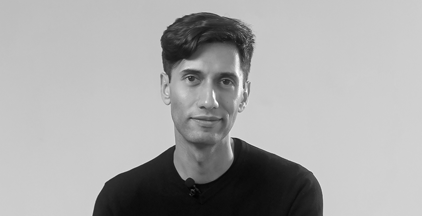
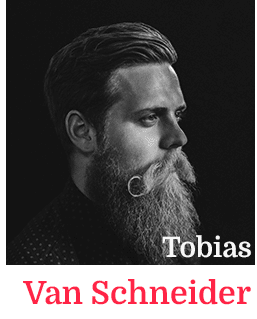
Tobias van Schneider is a German multi-disciplinary maker of useful, curious and beautiful things, as he likes to describe himself. He has started and been part of three key initiatives, Semplice, Carbonmade and mymind, working with designers, illustrators and artists. He regularly writes about design and productivity and has also written a book.
Today, Tobias van Schneider works with a team under the name House of van Schneider (HOVS), influencing and shaping products. In an interview with TIA, he went through his personal journey and explained what HOVS means to him. He also explained how he balances the creative aspect of design with the practical requirements of a project and listed his design principles.
To begin, what drew you to New York City as a place to call home and establish your professional life?
Tobias van Schneider: I have always enjoyed following my curiosity, trying everything and putting myself in new situations where I may learn something. I thought New York may be the best place for me to do so, and I was right.
New York is also scrappy, and I love that about it. As someone who likes to create new things and run a business, that excited me. They say the US is the land of opportunity, and New York makes you aware of that truth more than any city I’ve ever been to.
Imagine we’re taking a journey through the streets of Tobias van Schneider ’s childhood cities. What sights, sounds, or experiences from those days do you remember fondly, and how do they connect to your work?
One of my “talents” (some family members keep making fun of it) is that I have incredibly bad recollection of the details of my childhood. I basically forgot most of it. But I’ve come to think of it as a beautiful thing, because I keep re-experiencing my own memories through other stories.
What does House of Van Schneider mean to you?
It’s my playground. A place where ideas, experiments and some of my proudest work (much of it accomplished alongside the HOVS team) all mixes together. House of van Schneider represents my desire to design the world around me and create beauty just for the sake of it.
Can you walk us through your typical workday routine?
I wish I had a romantic ritual to share with you, but my typical workday consists of pushing ahead various projects and small tasks between many calls and emails. If I get the chance to spend a solid hour writing a personal essay or designing between it all, it’s a beautiful day.
How do you balance the creative aspect of design with the practical requirements of a project, such as client needs and deadlines?
The client needs and deadlines drive the creativity. Without them, I am aimless and unmotivated. The fact that we are usually our own clients working on our own products doesn’t change that.
Since we’re a tiny and independent team, we have the luxury of avoiding the bureaucracy that typically gets in the way of creativity at your typical agencies. That helps with creating a balance; we are pulled in fewer directions and tend to waste less time on politics. When we do work with clients, we are very careful to choose those that respect our opinions and our time (I realize this may be a luxury as well).
I also work iteratively and non-linearly. If I’m hitting a creative wall, I don’t sit there and try to force it – and I try to avoid putting myself in situations where I have to. I encourage my team to approach their tasks the same way. If you’re stuck, move on to the next thing and come back to it later with a fresh mind. I don’t expect immediate perfection with my creative work, but instead enjoy nudging it along until I’m happy enough with the result. I am constantly moving around and jumping between dozens of different things in a day, but always moving forward.
You had the opportunity to design the identity for NASA’s Mars Rover launch. Could you walk us through your workflow and the steps you take from concept development to execution?
Yes we did! I’d love to share the process of this government project, it all started with – *FBI knocks on the door*
(We’re sadly not allowed to share these details beyond what we share here, but I can assure you it was similar to every design project you’ve ever worked on.)
Are there any specific industries or sectors that House of Van Schneider is particularly passionate about working with or contributing to?
We do have a taste now for designing logos for rockets. Otherwise, we love creating tools for creative people. Our current products – mymind.com, carbonmade.com and semplice.com – are all made for visual, thoughtful people who hold themselves to high standards. We’ll always have a special place in our hearts for the designers, artists, illustrators and others, and aim to create tools that complement their work and their minds.
You’ve been able to collaborate with so many brands in your career, but what mistake have you seen from companies trying to stay relevant?
Getting so caught up in trends they quickly make themselves irrelevant.
In your path as a designer, what design principles or philosophies do you consider to be fundamental to your work?
- Patience – The understanding that efforts build and compound with time. Which goes hand-in-hand with humility, the willingness to do the small things with just as much effort and passion as the big things.
- Curiosity – A religious dedication to learning and exploring outside the field of design.
- Follow-through – The commitment to doing what you said you were going to do, when you said you were going to do it.
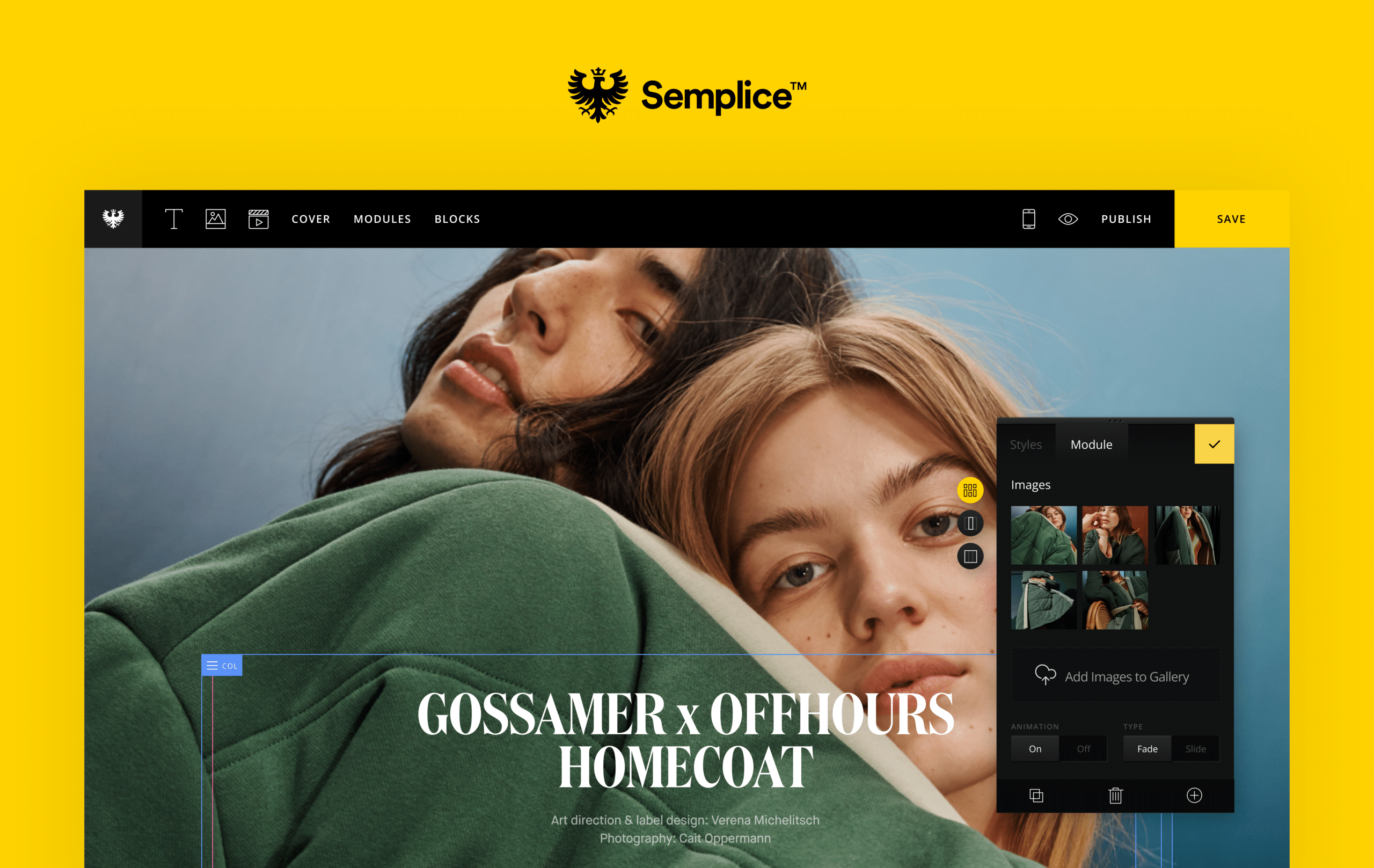
From Tobias van Schneider ’s perspective, what are some common challenges that designers face when it comes to showcasing their portfolios, and how do Semplice™ and Carbonmade address these challenges?
The most common challenge is making time to update our portfolios or build one at all. Even I’m guilty of the first one sometimes, although I try to continually make small tweaks and updates that keep it fresh.
Related to that, overthinking and allowing ourselves to be overwhelmed by the project. We fear our work isn’t good enough, or that it’s not ready, or that we don’t have time to focus on it. So a portfolio can sit for literally years half-finished – at which point the projects are outdated, our style and interests have evolved, and we feel like we need to start the daunting process all over again from scratch.
Both Semplice and Carbonmade address this by making it easier and more fun to build your site. With Semplice, you’re not limited to templates that confine and confuse you. You have full freedom to design and build your site around your work. With Carbonmade, we give you blocks you can work with as a foundation, eliminating the overthink and time-consuming challenge of design (neither platforms require coding).
And because both are flexible and easy to use, you can keep your portfolio updated over time. It doesn’t require a daunting redesign or starting from scratch with a new template every year. You just update your homepage, swap out your navigation or add a new project, and you have a fresh site.
You’ve been involved in mentoring and advising various programs and organizations. How important do you think mentorship is for emerging designers, and what advice do you often find yourself giving to mentees?
I can thank my mentors for every breakthrough and accomplishment throughout my career. Most of those mentors, however, didn’t know they were my mentors. I’ve received invaluable advice and wisdom from books I’ve read and people I’ve admired from afar, and I believe that can serve just as well as a real mentor.
If you’re lucky enough to find a person that inspires and encourages you in real life, count yourself lucky. Learn from them, take everything they are willing to offer you with excitement and humility, thank them and move on.
Excitement and humility – that’s the advice I often give to young designers. Don’t resent doing the small things when you start out, and when you’re far into your career. Do the small things with passion and excitement, and you might turn them into big things. That goes for working at “non-design” companies that may not seem so glamorous and trendy. Take the opportunities given to you and run as hard as you can with them. Working at a no-name company on no-name projects means you have an opportunity to make a name for that company and those projects.
In your LinkedIn, under Education, it says that you went to “The School of Life”. What’s your take on the current education system?
I dropped out of high school and never went to a university. I found school confining, unhealthy and ultimately not useful for my goals. That may not be true for others. We still live in a society that values traditional education, especially in the United States. That reason alone can make it worthwhile to participate in it.
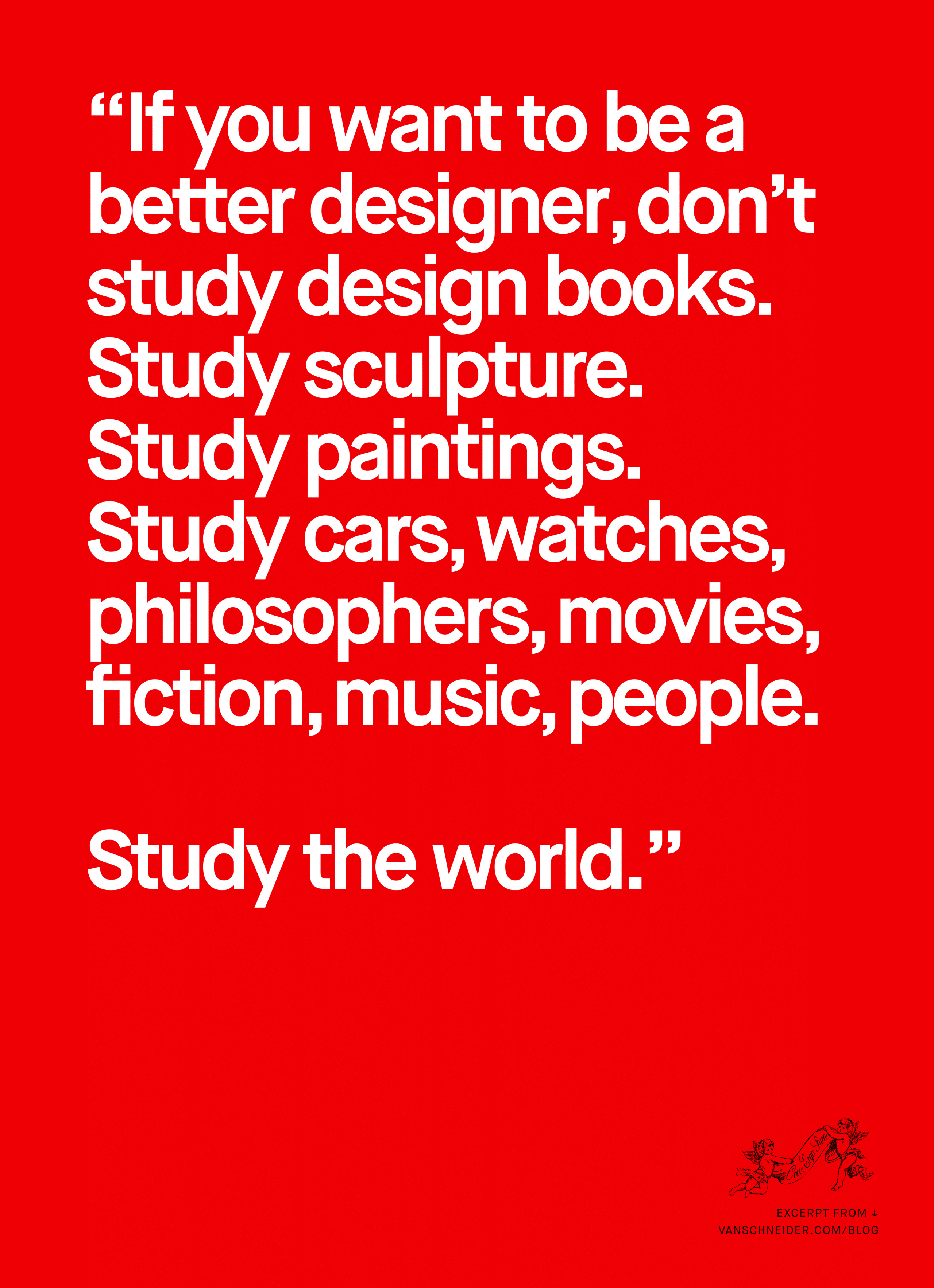
That said, I find university learning less relevant than ever in the field of design. Everything I know, I’ve taught myself through online reading and constant, obsessive experimentation. The funny thing is, I don’t often see successful designers who set out with the intention of “being self-taught.” They were just unruly, curious people who didn’t even know they were teaching themselves design until they found themselves being designers. I wrote more about that in this article and this one.
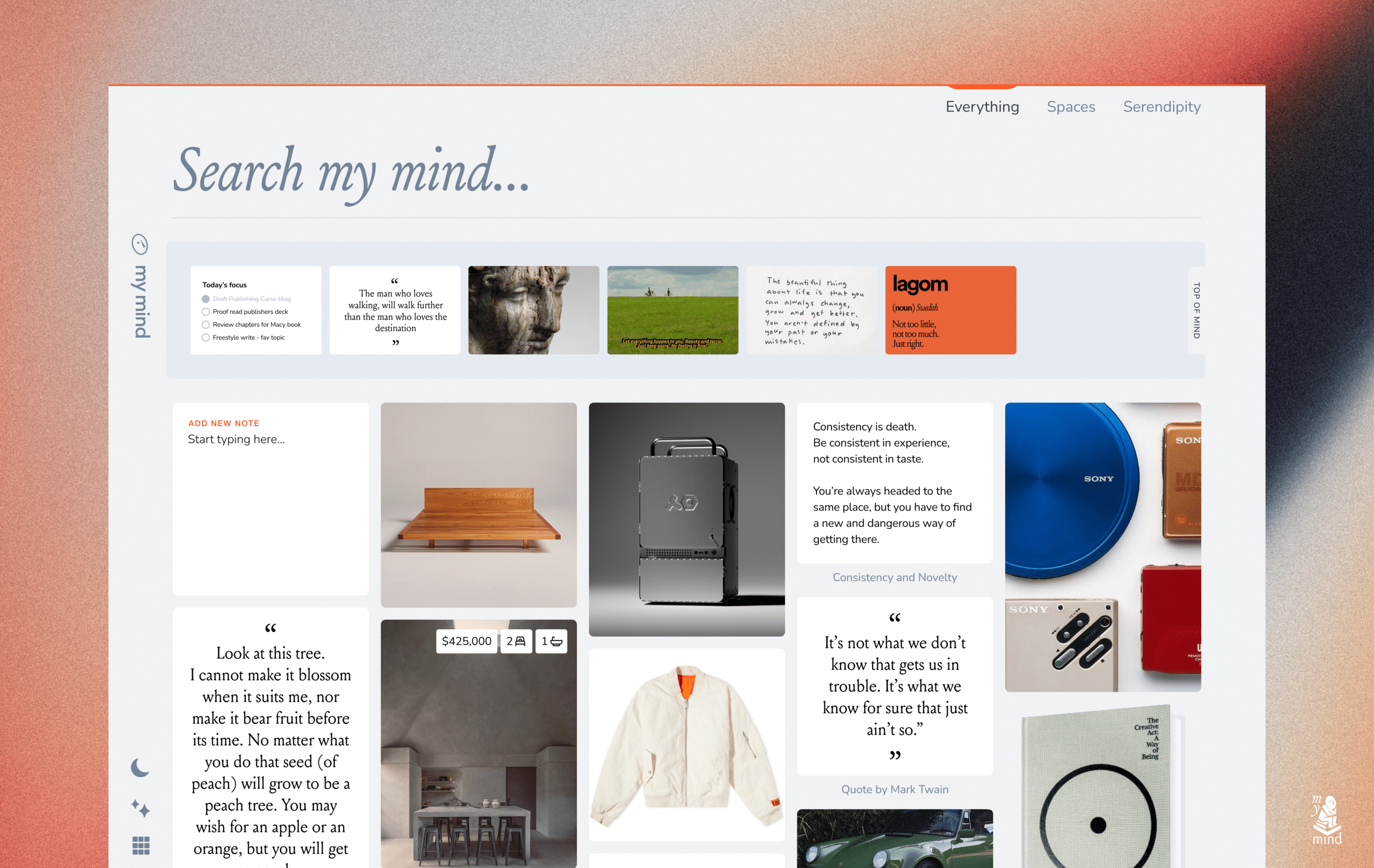
You recently co-founded mymind.com, a privacy-first tool using artificial intelligence. How do you see AI shaping the future of productivity tools, and what motivated you to develop mymind.com?
I hope, like mymind.com, AI will shape the future of productivity tools by squashing the term “Productivity” – at least as we use it today.
Within the last 10 years, “productivity” has amounted to nothing more than managing our tools. From reaching “inbox zero” to organizing intricate project management systems, we’ve been striving for productivity without accomplishing much at all. Our tools have sapped our energy and our time. They give us a false and fleeting sense of satisfaction, with a strong undercurrent of anxiety.
I hope AI will put our tools in their place, by making them actually serve us as tools. That means less mental effort and energy required by us, and hopefully a greater sense of peace and clarity as a result.
That’s our goal with mymind, and what inspired us to create it at the beginning. The internet and the endless tools that come with it have made us feel scattered, disorganized and anxious. We aim to put the “intelligent” part of the AI to the test, and offload some of that mental toll to technology. We have a ways to go toward that goal, but we’re getting closer and closer every day.
As we peer into the crystal ball of technology, what are your prophecies for the next chapters in the interactive sector’s evolution?
Our industry is obviously changing with the evolution of AI, and fast. For example, I already see fairly good AI product displays made in a minute, which previously required weeks of work from photographers, art directors, designers and more.
That’s good and bad. It will make us more efficient. But it will also make our designs, and the companies touting them, even more generic and trend-based than they have been with humans at the helm.
The smartest agencies will stay small and focused. They will rise to the surface because they are refreshingly human and unexpected in an increasingly inhuman, expected world.
Can you name the global issue you are most passionate about and why?
Personal privacy. It’s becoming increasingly difficult to have it, even for those who make a concentrated effort to find it. Others willingly throw it away, and I don’t think we’ve yet realized or understood the cost. But we will soon. As you might have guessed, this is why (in part) we created mymind. The fact that our tool is an exception today signals the dire need for it.
Please share a fun fact that not many people know about you.
I professionally played World of Warcraft. In fact, I spent over one year in-game (according to game stats).
Van Schneider’s Working Preferences:
Early Bird or Night Owl?:
Night owl
Usual breakfast:
Bacon, Egg & Cheese sandwich. I’m full-on American now
Most quoted book, TV Show or movie:
The book, “Man’s Search for Meaning”
Last place traveled:
Austria, unless you count my motorcycle day trips upstate
Favourite music genre or band:
I listen to everything from house music to Enya. I love you, Enya
The game you’re best at:
PUBG
Preferred spot in your town:
Pastis
If you could be any fictional character, who would you be?:
The person I imagine I will be tomorrow as I go to bed
What is something on your bucket list that you haven't done yet?:
I’d like to design my own analog watch
Thanks Tobias van Schneider!
- Learn more about The House of Van Schneider
- Follow Tobias van Schneider on social media:
Agency to watch

Best in Breed since 1998. Lounge Lizard is a Digital Agency that Specializes in Brand Strategy, Website Design, Web Development, Mobile APP Development, Online Marketing, Social Media, Ecommerce, and SEOdigital experiences that move brands and businesses from now to next.
Featured agencies

134970 Views

115530 Views

109320 Views

91805 Views

88261 Views

83070 Views

74693 Views

61505 Views