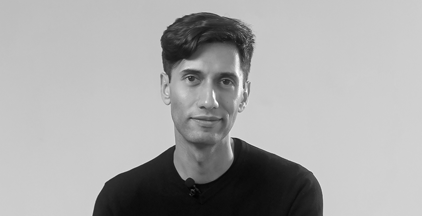
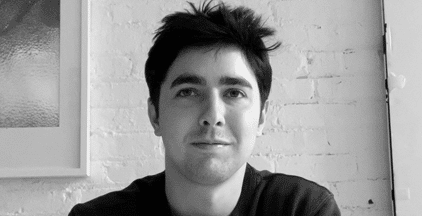
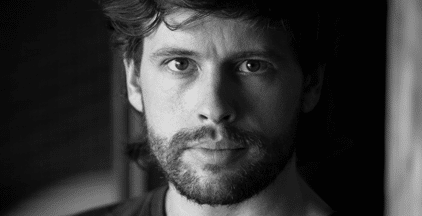
Elmar Kruitwagen: “I believe everyone should be a creative beyond their profession”
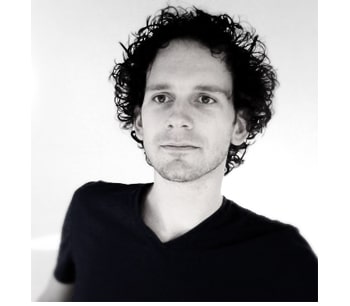 Amsterdam, January 8, 2015
Four friends were looking for adventure and decided to create their own creative agency. They challenged themselves with the belief that creativity can overcome all limits. One of those guys was Elmar Kruitwagen, now Design Director at Keplar, a successful digital agency located in Amsterdam.
Elmar enjoys the adventure they once created and speaks without hesitation, as someone who’s driving a quite well-known boat.
What does creativity means for you? What’s creativity in your life?
I think creativity means having an open view and taking into account all the possibilities that are waiting for you. After hovering around it’s time to experiment, to find those connections that together build up your story and the right perspective. I believe everyone can be creative, beyond their profession. Not only the creative director should be creative within your company.
If you had to choose one person as a creativity icon, which one would you choose and why?
Stanley Kubrick, the film director, is a great creative example for me. I admire his powerful imagination and visualization.
Where do you look for inspiration before you start a project?
I find inspiration within different fields of creation. Digital designers tend to design in their own digital dimension. On Dribble for instance I see young designers ‘seeking inspiration’ in each others work trying create something new, and end up doing the same. This copy-catting as a process is interesting as well, but it doesn’t push you to have an open and innovative view. I think it’s interesting to look beyond your own profession and develop different perspectives. It’s can be refreshing to see how other processes in other fields of design work, like architecture for example.
I consider inspiration not as a rational thing, but mostly as an unconscious one. So, doing different kind activities in or outside your office, like going to expositions, listening to a good band or even do groceries, automatically can inspire you when you aren’t looking for it.
You were one of Keplar’s founders. When did you decide that you wanted to create your own agency and what challenges you had to succeed on that?
Before starting Keplar, I had freelance activities going on with one of my current partners. We began a graphic studio that was going well but we came to a moment in which we were seeking for new adventure. We wanted to reinvent something. We met two guys that were active in the production of digital products and tried to discover if we could team up, broadening both our activities. It worked out really well and somewhere in that process, about three years ago, our agency was born. It all went very natural for me, it was built step by step, each time trying to adapt to new situations. Of course there are lots of challenges along the way. You’ll have to invest a lot of time to get your business going, big financial rewards shouldn’t be on your mind in the first period. You also got to be flexible, there are things you cannot plan. And most importantly it’s all about having a passion for the things that you are doing.
How’s a day in your life?
I wake up, I have a small breakfast and I take a train to the office. That’s a very nice moment for me because I have half an hour to get awake, and to get an idea what is going on in the world. Then I arrive at my office and I start working. I have two kinds of activities. On one hand, I have to manage the team and the business with my other partners. Besides that I have my design work. So I start with the managing part, do meetings, discuss projects and communicate with people involved in the projects. Mostly in the afternoon I do my design activities. Those are activities in which I like to focus for a longer period of time. Headphones and good music really help me in that situation.
What advice would you give a creative that’s stuck in his or her work?
At first I would try to open up your process to other people, receive opinions, talk about your ideas and try to see why you are stuck. I think in some situations creative results emerge more easily when you do them within a team. It can also be that your head is full of repetitive ideas. It can be good to go outside and refresh your mind. When you want to find solutions in the designing process itself you can try to change your approach. For example you can create design rationally with rules, stories and requirements, but you can also experiment, go with trial and error and see what comes out. Possibilities can arise that you didn’t see before.
What was your most creative project?
So far, our most creative project was a platform we designed called the Academy of Electronic Music. We had to create the whole product including the brand from scratch in less then two months. It became a platform for young music producers to give them a place to promote their own music. It worked out great because with the right people we managed to make it one big team effort. Afterwards when we saw it had great effect and lots of people around the world got something out of it, it was very joyful for us.
Technology is constantly mutating, being a creative some years ago was completely different from creating nowadays. I would like you to take the risk, and predict which important changes will take place in the near future.
I think in some years we will finally have built a bridge between digital and physical products on a smart an integrated level. If we reach this point, we will open up a spectrum of possibilities to combine technology with any shape or material. The focus will shift from digital screens to new forms of communication. So ‘websites’ won’t be just websites anymore the way we know them now.
Do you find that counting with a small budget is a limitation for creativity?
I think quality depends on different components. Time and budget need to be just right to have the motivational drive that’s needed to create something really special. Of course you can design things with a very small budget but if a qualitative product is your goal I consider the best results will arise when the values for time and budget are in balance. You will get the best out of specialized people.
What tools do you think are necessary to lead a team? How do you do in order to unite different ideas and give space to each member’s creativity?
At first you have to be open to the fact that everyone has its own design methods and views. You have to respect their processes. When you are leading a team you have the tention to shape projects to your own processes and ideas but this doesn’t work. It is important to give people enough freedom to create their own things and follow their own way to achieve their best results. But you also have to steer, provide perspective and show the right direction. So it’s a balance between freedom and boundaries that has to be found for each project.
In a revision process I think it’s important to take time to see what is going and how the process went. It can give way to more tactical feedback, because designing something is often very personal. Like an onion, you can break down the layers and try to get the bottom of whats wanted.
Thanks Elmar!
Learn more about Keplar Agency
Follow Keplar Agency on social media:
Facebook
Twitter
Instagram
Linkedin
Agency to watch

Best in Breed since 1998. Lounge Lizard is a Digital Agency that Specializes in Brand Strategy, Website Design, Web Development, Mobile APP Development, Online Marketing, Social Media, Ecommerce, and SEOdigital experiences that move brands and businesses from now to next.
Featured agencies

135040 Views

115591 Views

109358 Views

91841 Views

88321 Views

83117 Views

74743 Views

61550 Views