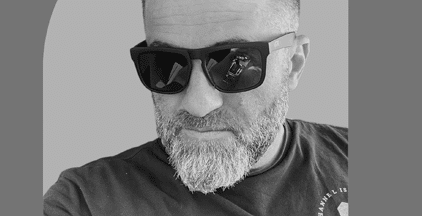
Justin Kase, digital agency with scandinavian stereotype
Stockholm, November 10th, 2016
Upon hearing the phrase “Scandinavian Design”, most people think of words like clean, modern, and progressive. The Stockholm-based digital agency, Justin Kase, is no exception to that positive stereotype. Founded in 2009, Justin Kase has quickly grown to become a highly respected and innovative design and development agency in Sweden. Some of the agency’s core pillars include strategy, digital development, design, branding, motions and graphics services. The agency was recently awarded a prize for the best interactive company. From working with well-known international clients like Avis, Vice and Asics as well as Swedish clients such as Oscar Jacobson, Kreab and Fyndiq to developing innovative solutions for the Swedish financial services sector with Erik Penser, Nordic Growth Market and Palette on the client list, the crew at Justin Kase is well-versed in servicing a wide array of niches.
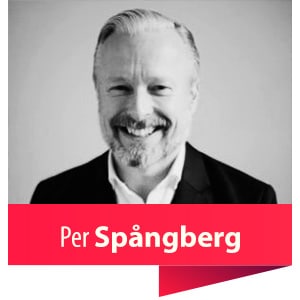
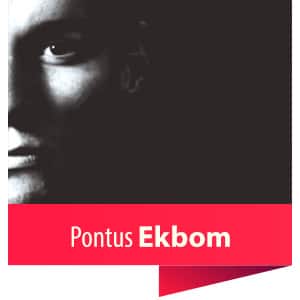
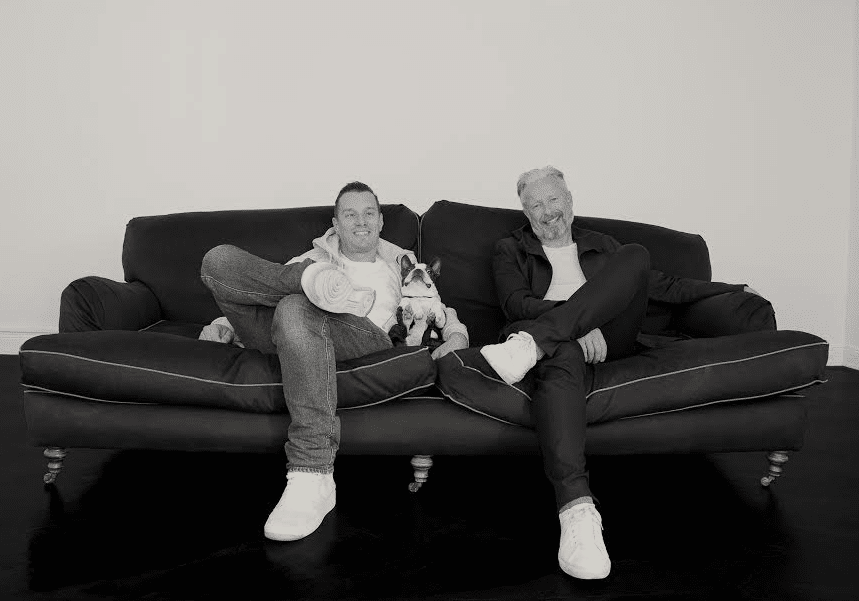
Leading this successful team are Founder and Creative Director Pontus Ekbom and his partner and acting CEO, entrepreneur Per Spångberg together with key partners and co-owners Andreas Ekman, Magnus Peter and Ivo Wapstra. The Team led by the union of these two driven visionaries effectively blends artistry components with smart business insight.
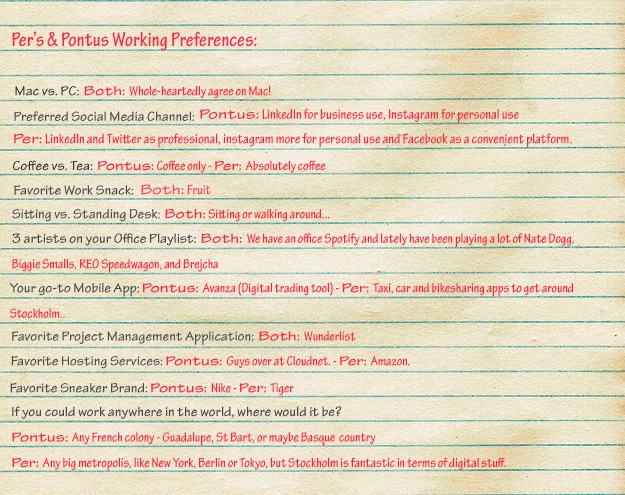
While Pontus and Per comes from differing professional and educational backgrounds, they are united in the passion for all things digital and the future path of seemingly limitless technologies. To understand the current digital trends in both Sweden and the Scandinavian market as a whole, we chatted with them to pick their brains on everything digital and tech, from the advice they would give recent graduates to their favorite digital brands.
Does Justin Kase primarily work with clients in Sweden, Europe, or all over the world?
Our clients primarily come from the Scandinavian market. Luckily here in Sweden and even more so in Stockholm, a lot of international brands have large offices for the Swedish market or even their European headquarters. Spotify is headquartered here in Stockholm along with many others, so we don’t have to go too far to find global clients. We’ve had the opportunity to work with top global brands like Vice, Asics, and Budget to name a few.
Describe the agency in three descriptive adjectives:
Creative, commercial, and agile.
What is your story working at the agency?
Pontus: My career path began at an early age when I was 18. I started working as a mixed position in an agency and then I moved up to an assistant and was eventually hired in 2000 at Sweden’s Ogilvy for a few years. After that I worked on various freelance gigs and projects, moved to smaller design agencies, and then I launched Justin Kase in 2009. To look back and see where we were as opposed to where we’re heading today with the business is incredibly exciting.
Per: My journey to Justin Kase took me through various business ventures and projects, In 1992, I graduated from Stockholm School of Economics and began working as a management consultant across Stockholm, Paris, and London. I went on to be a financial analyst for the Wallenberg family, otherwise known as the Rockefeller family of Sweden. After that I was the CEO, chairman, or part owner of a number of businesses across the technology, healthcare, financial services, and philanthropic areas. In this course of time I decided to focus on digital as I saw it as a great business opportunity. I have joined as a board member and co-founder of a number of digital startups and through my network I was lead to Pontus and his talented team.
What is a big challenge you face as an agency?
Pontus: The financial services niche can be tough at times. This industry has a reputation for being conservative and wary of modern designs on websites and materials. This can be restraining on the creative process as it’s difficult to do quality work when you feel that clients limits you. Speaking as a creative director, there are times when I have to hold back and adapt to the situation and motives of the client. Flexibility and empathy are crucial to do this work. While some agencies would just push stuff onto clients, we make sure to truly understand their perspective and attempt to create the solution that they want.
While financial services can be a tough sector to shine creatively, we remain excited as more and more processes turn digitized. Here in Sweden, the Digital ID card is a collaboration between the government and all the banks. Currently some 70-80 percent of the population has access to this service. There are many uses, including rapidly transferring money and connect to your healthcare plan or tax account. Advancements like this growing use of the ID card is a change that helps overall for te financial niche to take a step forward in the abilities of technology and digital use.
Please list a few of your favorite digital brands:
Pontus: UBER sort of paved the way as an example of the type of service people want; personalized, high-quality, and easy-to-use. A few other brands that come to mind are AirBnb, Ebay, and, of course, Spotify.
Per: I’m always attending lots of meetings and there are a variety of options to chose from, but of course the names mentioned by Pontus comes to mind. If I should add something its when you have a digital brand that gives you a great service, saves money and also contributes to sustainability. The digitization of transportation is such an example, where I can check the availability of a Citybike, SL (Stockholm commuter services) for the metro and see how long it will take, while comparing it to the estimated arrival of an Uber or check where the nearest vehicle from Car2go or DriveNow is located. Those are very good examples of the sharing economy, utilizing existing resources better on the margin, while bringing huge value to me as a user. However, if I should mention one as my absolute favourite, it’s probably Spotify. To have access to the largest database of music globally, through a personalized interface, wherever and whenever I want – that is truly amazing.
What does creativity mean to you?
Pontus: A creative individual is an agile problem solver. Creativity isn’t worth any money if there isn’t an added business value to it. It’s crucial that the individual always understands what exactly the business value is for the client — is it a service or product? From there, the individual must adapt that creativity to the client in order offer tangible solutions. Not only is creativity problem solving, but also one should be able to combine interdisciplinary skills — mixing art with numbers in order to see all possibilities from different angles.
Per: I see the marriage of giving back and doing business as a strong form of creativity. A recent example is how digital gambling and gaming technology is being re-purposed for charitable and philanthropic organizations. The ability to take a prior technology and adapt it to be utilized in a new way or environment, where it might be even more useful or productive is extremely creative.
Another local example of creativity leading to innovation is iZettle, a Point of Sales software, that easily allows small vendors to accept card payments. Here in Sweden more and more people are using iZettle. A simple hot dog lunch in the street can be paid for with an Amex, something that wasn’t so common a few years back. With this creative technology, payments and transactions are moving people closer together as the digital spectra shrinks. It’s putting more power into everybody’s hands, especially self employed, entrepreneurs and small businesses.
Which countries excite you most in terms of digital creativity?
Pontus: Scandinavia is always in the forefront of design. Berlin is interesting, but can be a bit too hipster for me. I’ve seen the US with UK coming along with good digital agencies, especially Unit9 in London that I really like.
What do you like doing in your free time?
Per: Running and philanthropic work are two big passions of mine. Taking one’s earned money and doing good in return is something I try to incorporate into my daily life and into my entrepreneurship and it’s also imbedded into the DNA of our company. Over the years I’ve been involved in many philanthropic projects that have successfully blended doing good with business opportunities and ideas. Since I was a kid myself, I’ve been involved with the non-profit organization, Save the Children. My latest project on behalf of this organization was raising money on their behalf through my participation in the Berlin Marathon this September.
Pontus: Running, hunting, eating, drinking… and repeat!
What advice would you give to someone starting to work in this field?
Pontus: I started in this industry at 18 and I succeeded because I listened to senior colleagues. Sometimes people born in the 90’s go out thinking they’re top of the world. Being in an agency isn’t always going to be a golden experience everyday, but it’s crucial to get that experience. You need to get down and dirty from a young level and truly listen to those with more experience than you — that’s the only trick to get around in this business.
Per: As a business school student we studied both macro-, and microeconomics, talking a lot about marginal costs and revenue and how it all relates to economic growth. The sharing economy, that uses resources much more efficiently is here to stay even if it might not always lead to economic growth, that’s a new mindset — young people should take advantage of that and make the most of the opportunities created from this shift.
Where do you see the industry heading in 5 or 10 years?
Pontus: Here in Scandinavia, we see this massive data push only continuing to surge ahead, especially with personal data used by the government. Being a governmental body, they’re forced to have open APIs. I’m very sure this is going to explode even more in the coming years.
Per: Internet of Things is another trend that I predict will continue to grow, especially through the introduction of 5G within mobile communications. Turning on your heat, oven, music, lights or any other system or appliance in your house using an app and other similar activities will soon be everyday tech I think.
On a recruitment level, we see us hiring more specialized developers. We’ve had IOS developers as well as traditional web developers, and as we move forward we will look for developers that possess both the technical skills and design understanding to work for example with applications related to Internet of Things. This will most likely raise the demand for UX and UI designers that have the ability to go to deep technological levels. It will be an interesting shift.
As a last comment Per and Pontus lets us know that they are planning a gradual shift in the brand of the agency, as well as broadening the offering within the near future, in order to to meet the challenges their customers are facing, as well as to capture interesting business opportunities and stay at the forefront of innovation.
Follow Justin Kase on social media:
Facebook
LinkedIn
Follow Per Spångberg on social media:
LinkedIn
Twitter
Instagram
Facebook
Follow Pontus Ekbom on social media:
LinkedIn
Agency to watch

Best in Breed since 1998. Lounge Lizard is a Digital Agency that Specializes in Brand Strategy, Website Design, Web Development, Mobile APP Development, Online Marketing, Social Media, Ecommerce, and SEOdigital experiences that move brands and businesses from now to next.
Featured agencies

135035 Views

115587 Views

109356 Views

91837 Views

88316 Views

83114 Views

74740 Views

61546 Views