The Top Seven Anti-Patterns of Boutique Digital Agencies
The Top Seven Anti-Patterns of Boutique Digital Agencies by Aurimas Adomavicius:
An anti-pattern is a common response to a recurring problem that is usually ineffective, and even risks being highly counterproductive. A good example of an anti-pattern in web design is the use of carousels. A carousel should, theoretically, allow you to control and expose additional important content, but carousels are actually completely ignored by visitors based on user tests. In this unapologetic article, I explore some of the most nonsensical quasi-truths that permeate the digital services industry in hopes that we, practitioners of this craft, can all become better at servicing our clients.
The topics in this article are controversial, likely to spark emotions in many of us from this industry. We’re just as guilty of practicing some of these anti-patterns ourselves in our six year operating history, but the idea to write this came as I was participating in Owner Camp in Portland this year. I met some of the most passionate, genuine, and intelligent business owners there from companies I’ve aspired to be like as we were building our own little business. The fact that a lot of folks succumb to these anti-patterns just leads me to believe that we’re not always (or most of the time) rational in our decisions. So here are seven anti-patterns that boutique agencies often embrace.
1. We Will Not Do Free Spec Work
There are many flavors to this one: we will not pitch, sell without pitching, the anti-spec campaign, and the list goes on. The design world specifically seems to have a bone to pick with clients that require vendors to respond to RFPs with proposals and prototype work. One of the best books I’ve read on the topic is called “The Win Without Pitching Manifesto”, and it explores the strategy of how competitive positioning and an engaging sales process should be used to reduce the reliance on free creative work before signing the contract.

What I would recommend, however, is to set your emotions aside for a moment. Winning business costs money, and you should understand that cost in your business. As you are building your sales and marketing budgets, calculate in the hours your team will need to spend a year building concepts and prototypes. Keep in mind, this is not free work, this is an investment you’re making to potentially win a $1-million-per-year account. Deciding which opportunities to invest the time and effort into is an entirely different topic, but use your judgment based on buyer’s authority, need, budget awareness, and strategic alignment to your objectives. Boycotting RFPs and creative work during the bidding process may close off some really interesting and valuable doors.
2. We Will Be Selective of the Work We Do
I am not sure if this is a real anti-pattern or a fictitious one, but I often hear businesses say that they pick the interesting projects to work on versus the mundane ones. I have a tingling sensation that in reality there are two types of organizations:
- Ones that select business based on strategic criteria, such as availability of budget, fit of expertise, and preferred scope (the good guys);
- Ones that select business based on emotional, philosophical, and purely egoistic agendas alone, such as passion for subject matter, moral alignment, and so on (the irresponsible guys);
The beef I have with the second approach is that it is an irresponsible way of managing the new business pipeline. I realize that it may be an attractive option if you’re drowning in opportunities, but your clients don’t care. In fact, your bandwidth should increase as your opportunity pipeline increases. If you’re only going after 10 percent of all the work you could be getting, you’re on a destructive path that will lead you to a place where that pipeline dries up in the long term. Clients don’t care that you’re selective. They don’t care that you’re the best of the best. They have a need today – and if you can’t cater to it, they’ll go somewhere else with a bad taste in their mouths and never come back.
3. We Will Not Grow Beyond X Number of Employees
A continuation of the above, also known as “Companies Do Their Best Work at a Certain Size”. We do what we do because we authentically care about changing the world. The best way I know how to do it is through design and engineering – building great applications, tools, and platforms to help our clients achieve their goals. You can change the world in small chunks, or you can go after really large, impactful, and meaningful projects – and that requires organizational size, authority, and credibility.
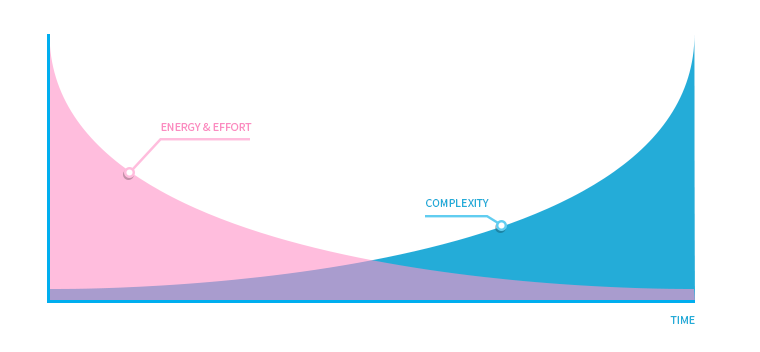
Figure above: We have noticed that the larger we become, and the more complex the project, the less effort it takes to close the deal.
Furthermore, through scale you can have greater impact on peoples’ lives at your own organization. Just last year we had fourteen babies as a company! Quantify the value and meaning of providing employees with great jobs and the income to grow their families. As you can tell, I am a big believer in growth. It allows people to graduate into new roles and responsibilities, it helps the organization acquire large accounts, and it provides revenue stability. So ask yourself a question – are you still a designer, or are you now an executive responsible for your employees and clients?
4. We Are Great At Everything
We all go through this phase in our growth because we need the business to keep the lights on in the office. You need a new logo? We can do logos. A mobile app? Sure, let me whip that right up. SEO? Of course, what self-respecting digital firm doesn’t know about SEO (pro-tip: most don’t know enough to deserve your money, look for a specialized firm or one with a proven track record). The reality is that you’re mediocre at best, and likely terrible when compared to world-class businesses.
Eventually you graduate out of this generalist strategy. Clients will beat you to a pulp over price if you’re a generalist, because they have fifty other shops that do just the same thing, for 50 cents less on the hour.
What we’ve learned is that focus is the key. Have a bank as one of your clients? Work to know as much as you possibly can about how banks operate, the needs they have, and the troubles they run into. All of a sudden, your hard work has made you rather specialized and expert at designing and building secure applications for banks that are deployed on the cloud – how more specific can you get? The funny thing is – you get more business from being a specialized shop vs. a jack-of-all-trades because you now have less competitors, you are an authority, and your solutions are results-oriented.
5. We Will Fire Bad Clients
In the service industry, we oftentimes mumble under our breath about how we would be better off without a certain difficult client. This usually happens after a steamy meeting where we had to compromise on financials or strategic decisions we passionately believed in. Like it or not, the client is always right. They keep my family fed and the lights on in the office. Difficult or easy, it is their trust in our judgment and our services that allows us to practice the craft we love. Respect that trust.
I have yet to meet a client who is difficult for the sake of being difficult. Some may be more sensitive to budgets, others to staying in control – even if they hired us as the experts to solve their problems. All of these frictions can and should be managed. Firing a client or terminating a contract because the project went south is your fault. The client was unresponsive? Visit them in their office. The scope is growing rapidly? Involve stakeholders that are sponsoring the project. Executives often times can solve some of the day-to-day issues when they see the full picture. Terminating is the easy way out.
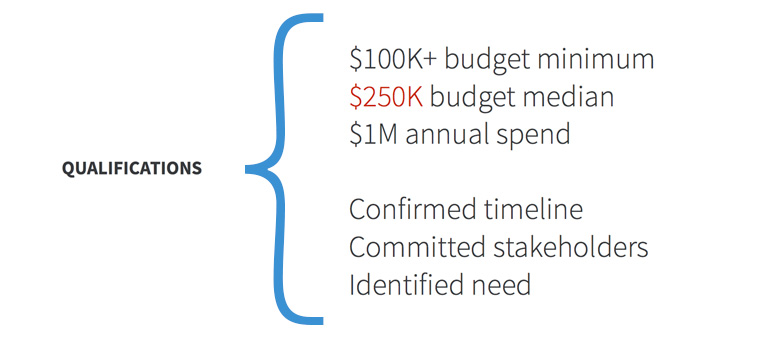
Above: qualifications we apply to new business acquisition.
On the other hand, you will out-grow some of your clients and you certainly should on-board only clients that match your strategy going forward. This will likely not be because of your rate, but rather the depth of expertise that you bring to the table. Some small businesses simply can’t justify the $30,000 R&D project you bundle with each engagement.
With all of this being said – we still service majority of the small businesses that helped us grow to be the company we are today. We have an obligation to these clients and the trust they’ve placed in us.
6. We Will Use Value-Based Pricing
Using a value-based pricing strategy means that you set prices based on the perceived or estimated value that your services create for the customer. For example, if your customer is able to save $10 million as a result of the platform you implement, your compensation should be $1 million versus the actual cost plus markup of the work done (which may, in this instance, be only a quarter of a million dollars). This practice, theoretically, should guarantee higher profit margins versus the classic cost-plus pricing.
The problem with this strategy is that it simply doesn’t work with sophisticated buyers. There are exceptions in luxury markets because purchases are being made based on emotions (e.g. Rolex), but the CMO that is doing the buying at Coca Cola didn’t get to do that job by making decisions based on emotions alone. Furthermore, there are always going to be companies out there using cost-plus pricing that will get a severe edge during the process.
I always come back to analyze the motivation of folks that preach value-based pricing. It seems higher profitability is always the objective, but no one ever considers a healthy profit margin at scale as an alternative. Why put yourself at a competitive disadvantage?
7. People Work for Us Because of Our Culture
First and foremost – let’s not confuse culture with perks. Too often I see startups bringing chefs in for lunch cookouts, purchasing foosball tables (guilty as charged), and playing “Rockband” in the office as a representation of their laid back, work-hard-play-hard mentality. That’s not culture – that’s a misguided college fraternity that is roleplaying a business.
Second, culture sets the ethical and philosophical direction for organizational behavior. It is defined by leadership, embraced and further augmented by the team, and is the grease that makes really difficult things bearable and the good times memorable. Culture itself, however, doesn’t retain employees, bring business, or make you profitable.

Above: Professional development session at Kaunas Devbridge Group office.
Employee motivation and retention is based on three very basic needs:
- the need to grow and be challenged;
- the need to be recognized and compensated;
- the need for things we build to matter;
So before you overspend or over-market your culture, focus on the three core competencies above to create meaningful and measurable value for your employees and clients.
It Is Not All Black and White
Acting mature as an organization does not mean you need to be a large company. Growing beyond a boutique size has allowed us to dig deeper and eliminate these anti-patterns from our daily operations, but I wish we could have avoided some of the mistakes. I hope that the readers of this article can apply what we’ve learned to their businesses and have happier, more successful clients as a result.
I think we form anti-patterns subconsciously. They’re all about topics we care passionately about, but also are frustrating and hard to find solutions for. Instead of looking for solutions, we turn to creating Band-Aids. It’s time we ripped them off and went in for surgery.
Source: http://www.devbridge.com/articles/the-top-seven-anti-patterns-of-boutique-digital-agencies/
banksclientsCMOculturedesignerFirstmotivationnewsprojectsSEOshopstrategic
Agency to watch

Best in Breed since 1998. Lounge Lizard is a Digital Agency that Specializes in Brand Strategy, Website Design, Web Development, Mobile APP Development, Online Marketing, Social Media, Ecommerce, and SEOdigital experiences that move brands and businesses from now to next.
Featured agencies

135036 Views

115588 Views

109356 Views

91838 Views

88317 Views

83115 Views

74741 Views

61547 Views