UX Without Interfaces: The Next Frontier for Interactive Agencies
The future of user experience is being rewritten right now — not in pixels or menus, but in intent, context, and adaptive systems. As digital ecosystems become increasingly powered by AI, ambient computing, and predictive logic, the traditional screen-based journey is no longer the default. For interactive agencies and digital strategists, this shift isn’t a trend — it’s a structural transformation of the industry.
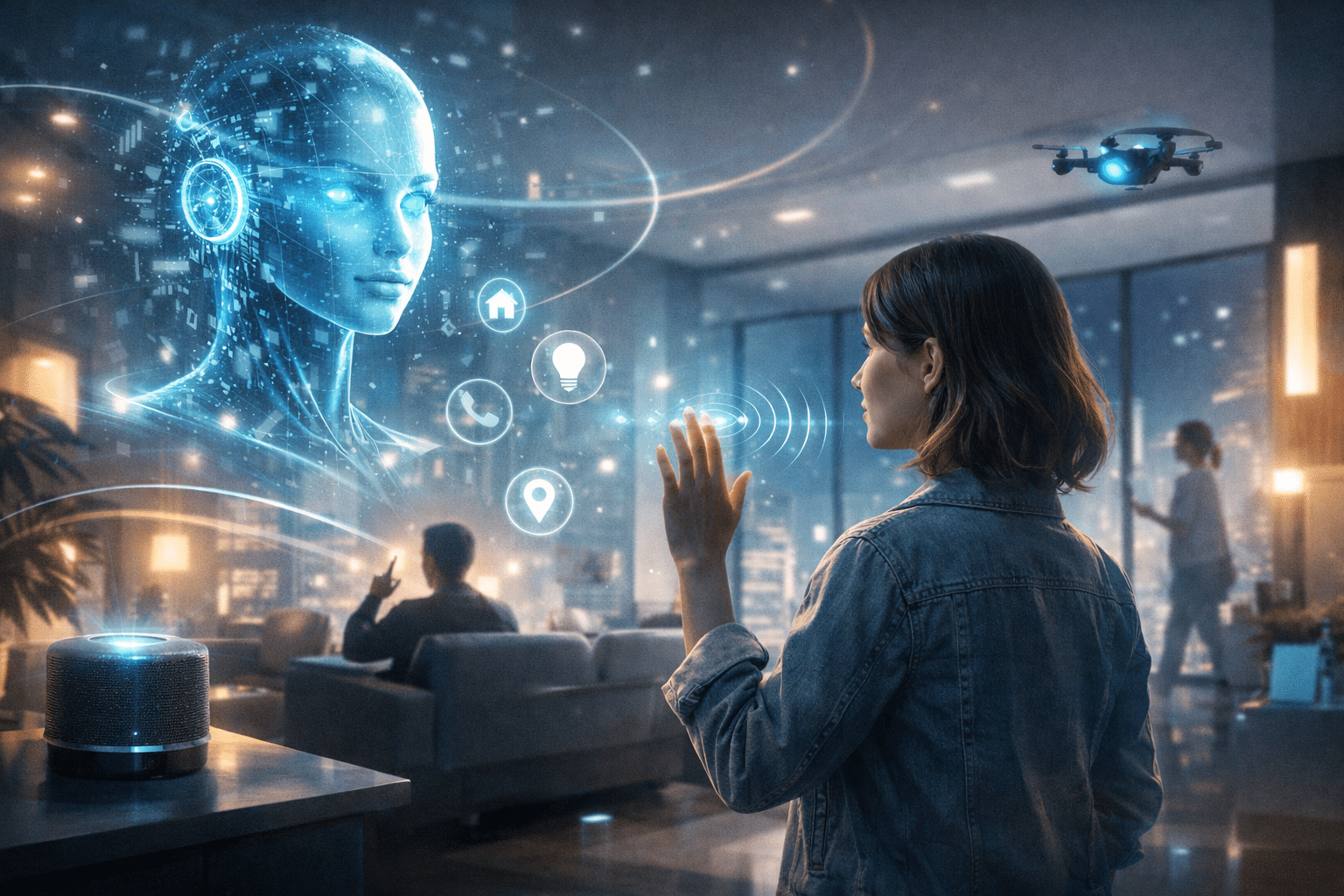
From Screens to Systems
For decades, UX design revolved around screens, flows, and visual interaction. The guiding metric was clarity of interface, the discipline centered on how users see and click. But 2026 and beyond points toward a future where the interface itself fades into the background.
Design is now about systems that anticipate, adapt, and respond — not interfaces that simply display. Today’s adaptive systems learn from user behavior and context to shape experiences that feel more like assistance than navigation. Instead of designing flows, designers will define behavioral logic and decision frameworks that govern autonomous experiences.
This aligns with a growing narrative in UX research: as AI agents act on users’ behalf, screens become secondary and agents become the primary surface of interaction. In 2025 reviews of UX trends, experts noted how AI is no longer a feature embedded in interfaces — it is the interface itself.
The Rise of Zero UI and Ambient Interaction
Emerging concepts like Zero UI and invisible design describe a world where interaction doesn’t require graphical elements at all. Users engage through voice, gesture, gaze, context and environmental cues, rather than taps and clicks.
Designers are now building systems that predict user intent and act preemptively, that respond to non-visual inputs such as sound, motion and location, and that create experiences that feel natural rather than structured. Interaction becomes implicit, continuous, and context-aware.
As one Zero UI framework describes it, interactions should be seamless, intuitive, and screenless, using voice, gestures, and sensors to deliver frictionless experiences.
This trend is not distant speculation — it is visible today in voice-first assistants, ambient IoT devices, and adaptive platforms that reshape interfaces based on context and user history.
Decision Design Over Interface Design
Traditional UX hinged on flows, funnels and pixel-perfect journeys. The emerging paradigm shifts responsibility from visual design to decision design: crafting the rules, predictions, ethical constraints, and logic that govern how systems behave on behalf of users.
This evolution challenges agencies to think beyond screens and embrace behavior-driven and intent-aware systems. It elevates design from craft to systems architecture — blending data science, ethics, contextual intelligence, and AI governance into the heart of experience design.
In this new era, UX increasingly becomes experience engineering rather than interface crafting. Success metrics move away from clicks and dwell time toward efficiency, relevance, and trust. Designers evolve into orchestrators of intelligent interaction, not just creators of visual flows.
The Human Dimension: Invisible, Not Impersonal
It’s worth addressing a common misconception: invisible interfaces don’t mean impersonal ones. The long-standing design principle that good design becomes invisible holds truer than ever. When design works well, it disappears into the background.
But invisibility today goes further. It means acting in harmony with human intent, perception and context. Users are no longer navigating interfaces — they are engaging with systems that understand and anticipate them.
What This Means for Interactive Agencies
This paradigm shift raises immediate strategic and operational implications for agencies.
1. Redefine Core Competencies
Agencies must build fluency in AI orchestration, predictive logic, behavioral modeling and ethical design, not just visual UI skills. Design teams will increasingly collaborate with data scientists, AI ethicists, systems engineers and behavioral researchers.
2. Innovate Business Models
Long-term retainer models based on episodic product launches give way to continuous system evolution. Agencies become partners in ongoing interaction optimization, not just launch teams.
3. Lead with Strategy, Not Screens
Clients will seek guidance not on what their products look like, but on how their services behave, what decisions they make autonomously, and how they earn trust in a world of invisible touchpoints.
Open Questions Agencies Must Answer
This transition is not without unresolved challenges. Agencies will need to confront fundamental questions: how to ensure transparency and control in systems that act on behalf of users; what accountability models apply when AI decisions shape outcomes; and how to define success when interactions are invisible and asynchronous.
These are not purely technical concerns. They are strategic and ethical dilemmas that will define the next decade of digital experience.
adaptive systemsAI and designAI-driven UXambient computingdecision designdigital experience strategydigital innovationExperience Engineeringfuture of UXgesture-based interactionhuman-centered AIinteraction designinteractive agenciesinvisible UXpredictive UXUX trends 2026UX without interfacesvoice interfaceszero UI
Agency to watch

Best in Breed since 1998. Lounge Lizard is a Digital Agency that Specializes in Brand Strategy, Website Design, Web Development, Mobile APP Development, Online Marketing, Social Media, Ecommerce, and SEOdigital experiences that move brands and businesses from now to next.
Featured agencies

135035 Views

115587 Views

109356 Views

91837 Views

88316 Views

83114 Views

74740 Views

61546 Views