“Every aspect of an experience contributes to its overall emotional impact.”
Resn is a creative agency with a digital obsession. Its singular vision is to infect minds with interactive experiences that amaze and stupefy.
 Wellington, April 14th, 2021
Since 2004, Resn has worked at the frontier of interactive development and design. Its highly-skilled team in Amsterdam and New Zealand has the expertise to take on complex technical challenges.
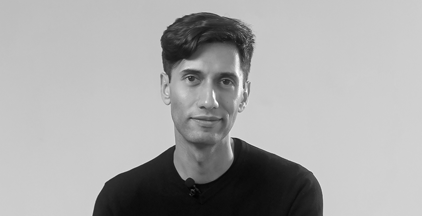
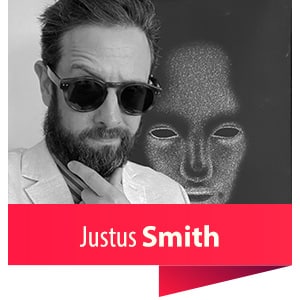
Working from New Zealand, Justus Smith is the Marketing and Communications Manager at Resn. In an interview with TIA, he described his early passion for digital experiences and his current role at Resn, connecting the agency with the rest of the world.
He described the elements that make Resn different and reflected on some of the most recent work.
To kick things off please can you describe to us a little bit about Wellington and why is a great place to work?
People say Wellington is the coolest capital city in the world. Having never lived in another capital city, I can’t disagree. I do know that Wellington is the premier creative hub of New Zealand, producing world-class talent as well as attracting it from all over the world. It’s a gravity well for creativity. The only drawback is the weather. As they say, you can’t beat Wellington on a good day, but those days are the exception rather than the rule.
The antidote for Wellington weather (and my recommended must-do experience) is horse riding on Wharariki Beach on a warm summer’s day. Its natural beauty and epic scale set against the exhilaration of being on horseback is, for me, unbeatable.
How did you first become interested in digital experiences?
It was many years ago, when I was a wee child in early-1980’s America. The olden days of digital. I was part of the first generation of child video game addicts. I begged for quarters on street corners and pumped them to arcade games to feed my addiction. Dark days.
I lived through the arcade boom, the rise of the in-home computer, and learned to code in BASIC as a pre-teen. The digital experiences may have changed but my addiction remains.
Could you explain to us briefly what’s your role as Marketing and Communications Manager of Resn?
As a practitioner of the dark arts of marketing and comms, I act as a conduit between Resn and the rest of the world (and sometimes between Resn and itself).
I attempt to draw attention to our work using every tool, skill, and medium I have at my disposal. That list includes social media, award submissions, press releases, newsletters, case studies, articles, user data and analytics, and more. Sometimes, I even talk to people in person. How very old fashioned.
What attributes do you want people to associate Resn with, and how do you align business decisions with your values every day?
Anyone who’s familiar with our work knows we produce highly interactive projects that, on the surface, can seem very disparate. Dig a little deeper and you’ll find some common threads.
Engagement and connection—we make experiences that go beyond the ordinary, in order to create connections between our clients and their customers. Interaction and experience—instead of treating users as passive consumers of information or entertainment, we involve them in the experience, allowing them to become active participants in the process. Surprise and delight—we aim to create things that are unexpected and amazing to make our users sit up and take notice, to bring a smile to their face.
You’ve probably spotted the pattern. Each of those attributes is about the same thing: being user-centric. It’s a philosophy that we call “Web You.0”. Maybe that sounds a little cute but it’s about recognizing that you, the user, is the heart of any experience. It’s this philosophical point of view that lets us align our projects to our values before we even start on the creative process.
Of all the recent projects your agency has produced, which one are you most proud of?
That’s tough because there are so many. Over the last year, we’ve worked with some amazing clients such as Sea Shepherd, who are working to save our oceans, VanMoof and Lucid Motors who are working on next-gen electric transportation, and Tony’s Chocolonely who are trying to eradicate modern-day slavery. The list goes on. But if I had to pick just one, for me it would be GOOD Meat.
For the last few years, I’ve followed the development cultured meat—meat that is grown from cells outside of an animal. Cultured meat technology has huge implications for the environment, for animal welfare and for human wellbeing. In December of 2020, GOOD Meat became the first company in the world to sell cultured meat to the public.
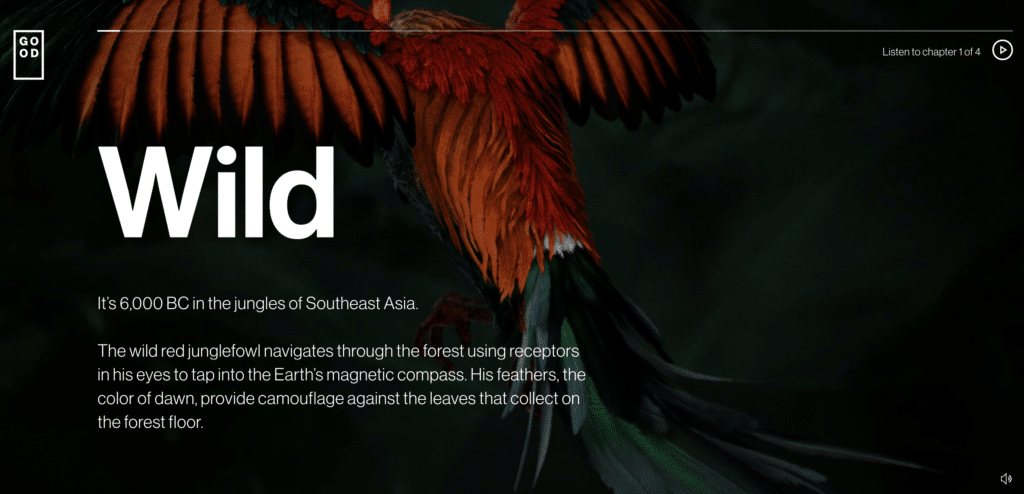
We helped introduce their product to the world with the website goodmeat.co. I think the site does a beautiful job of telling the story of the development of commercially farmed chicken, from its wild origins to its industrialization in the 20th Century, and how GOOD Meat can be a more sustainable, healthy, and humane alternative. It creates a powerful user experience for something that could have an enormous positive impact.
Every experience has an emotional component, and using products is no different. What is your approach to design positive emotions to keep users happy and engaged?
Every aspect of an experience contributes to its overall emotional impact. When every ingredient is working harmoniously together, you can achieve immersion. That level of engagement is our ultimate aim for every project.
If I had to pinpoint Resn’s particular expertise in the arena of emotional design, I’d narrow it down to three things: personalization, interaction, and storytelling.
Personalization gives a user their own doorway into an experience, allowing them to participate in a unique version of the creative vision and imparting a sense of ownership. If that experience is for a brand or product, personalization can have a powerful influence on creating positive brand sentiment.
Interactivity gives users a sense of agency in the experience, allowing them to be an active part of how it unfolds. Empowering users with agency heightens their connection to the experience. They become the subject instead of the observer.
Taking a storytelling approach allows users to connect the dots of the experience, piecing what could be disparate breadcrumbs together into a complete whole. Journeys that feel complete will heighten a user’s sense of satisfaction.
Accessibility can be difficult to acknowledge, how do you ensure that your clients understand what you are recommending and all users are considered during projects?
As awareness about accessibility increases, it’s becoming more important to what we do. Yet, we’d be the first to acknowledge that we have a lot to learn about accessibility. Many of our websites are outside-the-box user experiences that are, unfortunately, not accessible to everyone—at least not at the moment.
Others, such as Rightcar Safety Simulator, was designed with accessibility in mind and it is compatible with a screen reader, can be navigated with a keyboard only, and all the text has a high colour contrast ratio with the background.
Accessibility is something we’re getting better at and we’re learning and changing as we go. As for the future, we’re excited about the direction of browser development, which may make it possible for some of our canvas-based web experiences to be accessible.
We are living the most important pandemic in recent world history. How digital has changed marketing product launches?
So much has changed. In early 2020, experiential marketing evaporated overnight as the world went into lockdown. Live in-person events were out of the question. The world needed different solutions. We found a huge need in the product launch segment.
The first company we worked with was VanMoof, which produces next-generation e-bikes. They had to cancel their planned in-person launch for their S3 and X3 e-bike models. We helped them pivot to a digital solution, developing an online event for them that combined live-streamed video, short films, audio, interactive real-time 3D, commenting, and live audience Q&A. The experience engaged fans all over the world and became VanMoof’s most successful launch ever.
The system we used for VanMoof became the basis for our digital product launch platform, Toast. We’ve since used Toast to create launches for Maserati, Lucid Motors, Tony’s Chocolonely, and we have more launches in the pipeline.
With shopper behaviour changing, what impact do you believe machine learning and big data will have on the world of creative production?
Big data is an 800-pound gorilla pulling levers behind the curtain. Largely invisible to the general public, it is nonetheless powerful and omnipresent. Machine learning is still in its infancy, but it has huge potential. People have argued that these technologies will be the end of creativity as we know it. Others have said that they are the greatest gift to creatives in the history of marketing. The truth, as usual, lies somewhere in between.
I believe we will end up with a symbiotic relationship between technology and creativity where one will inform the activity of the other. Creatives will be able to draw insights from data and AI to fuel new ideas, which were once mere shots in the dark.
We’ve already used machine learning in creative ways, with chatbots and style transfers, and I’m optimistic that these technologies—if they can be directed and harnessed ethically, with adequate regulation and oversight—can be of benefit to everyone. Or else they’ll destroy the world. Who knows?
What advice would you give to a new non-profit startup that is looking to build a smart digital strategy?
Lead the narrative. Become the expert in your area so you can be a thought leader in your niche and a super-spreader of good information. This will enhance your reputation and allow you to build upwards from a firm mastery of the basics.
Social media is your friend and allows you to focus on attracting an audience that is as passionate about your mission as you are without a large upfront investment. But, don’t underestimate the resources that social media can take up over time.
The word ‘influencer’ has a lot of negative connotations, but the right influencer can amplify your message and help you level up fast. There are PR companies who can connect you with the influencer and, depending on how worthy your mission is, they can even do it pro bono.
Whatever you do, don’t build a website on the cheap. There’s a greater initial investment, but a poorly designed website can harm your credibility.
I’d also advise non-profits not neglect traditional media. If you’re a non-profit start-up, depending on your funding model, you will probably find one of the best bangs for your buck is in earned-media. If you believe in what you’re doing, others probably will too. If you’re doing something newsworthy, a well-crafted press release can get you a lot of attention for very little investment.
How would a good friend describe you?
I would hope they would struggle to answer the question because it’s too difficult to sum me up. Otherwise, I hope they’d just say something short and simple like I’m a good dude to be around.
Can you name a fun-fact people would be surprised to learn about you?
I hosted the breakfast show at my university’s student radio station five days a week for two years. If I could sum up my hosting style, I would use the phrase “I hate mornings”. And I still do.
Justus’s Working Preferences:
Remote Working Vs Office Working:
Overall I prefer not to work from home. I get claustrophobic. Thankfully, we've had a competent government response to the pandemic in New Zealand and life has been fairly normal
Wake up time:
Usually around 7am, when I am awoken by one or more of my three children. At least I think there's three. They're in constant motion, so it's hard to get a proper headcount
Usual breakfast:
Just coffee. I've been doing the intermittent fasting thing for about 15 months. No food from around 8pm until lunch the next day. It's great, except for the incessant hunger
Guilty pleasure:
Currently I'm falling down the rabbit hole of watches. I've acquired six timepieces in the last year alone. I think I have a problem. My bank account can't sustain this habit. Please help
Most quoted blog, book or movie:
I probably quote Star Wars way more than I should. I constantly have to tell my children "No, I am your father"
Last downloaded app:
I just checked and it was Hodinkee. I refer you to my guilty pleasure above
Favorite sneaker brand:
Gaziano & Girling. Except they don't make sneakers. But, then again I'm not sneakerhead. I'm a shoe snob...
Preferred spot in your town:
The balcony at Resn. Great view of Wellington Harbor
If you could solve one problem in the world, what would it be?:
Reverse habitat destruction. Our survival and the survival of life on Earth depends on the flourishing of the natural world. We live on a planet with finite resources. We can't keep doing this. Pls stop
Thanks Justus!
Follow Justus on social media:
Follow Resn on social media:
Agency to watch

Best in Breed since 1998. Lounge Lizard is a Digital Agency that Specializes in Brand Strategy, Website Design, Web Development, Mobile APP Development, Online Marketing, Social Media, Ecommerce, and SEOdigital experiences that move brands and businesses from now to next.
Featured agencies

135036 Views

115588 Views

109356 Views

91838 Views

88317 Views

83115 Views

74741 Views

61547 Views