UX is not just about pushing pixels around
London, July 1st, 2019

London-based digital agency Cyber-Duck has been conjuring UX solutions since 2005. Using UX, the agency has combined user-centred design with artistic, creative interfaces and technology to overcome the most complex requirements.
To create great user experiences, Cyber-Duck employs insightful experts such as Cristina Viganò. Cristina studied psychology in Italy and found her path when she attended a class on cognitive ergonomics taught by professor Paolo Cherubini at Milano-Bicocca University.
“I found cognitive ergonomics incredibly fascinating, and I then decided to specialise in cognitive psychology and Human-Computer Interaction (HCI).”
“After a brief time spent at the university as a researcher, I then started to work in a digital agency in Italy as a UX researcher. I am grateful to my boss back then (Antonio Bonanno), who took a gamble on me and allowed me to learn more about design on the job. I took the opportunity and thanks to the amazing team I had and the support of my UX colleagues (Roberto Falcone and Giorgio Montersino) I became a better UX designer, with a much wider range of skills.”
This journey eventually leads her to Cyber-Duck, where she’s been for the past two years. Cristina is senior UX designer at Cyber-Duck, and one of the things that set her apart is that she designs the UX with a real understanding what a client might feel and want, not only at the first point of contact with the user interphase, but also afterwards. This approach fosters long-term relationships.
She has recently been recognised as a BIMA Hot 100 Creative & Designers and agreed to tell us more about her take on UX, and what her current focus is.
Can you tell us about a project you worked on, and that was especially successful?
I have been working for over two years on a digital transformation project for a global company that provides prevention and support with health and travel security risk.
The company had been growing over the years, and they had ended up with many different systems providing a disruptive experience to the end user. After the first few months of research, I, together with my design team, was able to create a UX Playbook containing not only the research outcomes but also our recommendations.
We then moved onto agile sprints of the design and implementation of features. The users kept being involved throughout the projects through usability testing.
The project was successful, and the redesign of the final solution received a lot of positive feedback from the end users. The client was also thrilled with our work and with how the two teams worked together. So much so that they asked me to join them when presenting the first demo to their clients in the USA.
How do you define UX design?
I find it hard to define UX design, and I know that it’s hard to trace a defined line of where it starts and where it finishes.
For me, UX design is all those processes that allow to come up with a solution for a problem, and in which the solution is designed taking into account real users’ needs as opposed to designers’ assumptions. UX design considers users, their context and the business needs to make any decision along the process. I’ve helped my agency create a complete guide to UX, which you can download here.
We also developed UX Companion, which allows new UX designers with bite-size definitions of important UX terms.
What does it mean and what does it take to deliver great UX design?
I know that delivering a “great UX design” is usually measured with metrics: how many people use it, is the retention higher? Have sales increased? Etc.
But I disagree with this old-fashioned way of measuring UX, which is purely defined according to a consumeristic point of view.
For me, it’s hard to quantitatively define it, as it’s got a lot to do with how people feel when they interact with your product. How are they treated? What’s their feeling towards your brand? How much better are we making their experience? Note that I am not saying “how much faster” or “how much easier” they do something because these are not necessarily synonyms for ”better experience”.
Delivering a good UX design means putting the user and its context at the centre:
• How would I want to be treated if I was them?
• Would I want to have a speedy shortcut to purchase something faster?
• So fast that I don’t even get the time to think about what I am doing correctly?
• Yes, it might make my next task quicker and smoother, but how will I feel at the end of the month when I check my current account?
• And on a larger scale, what contribution are we ultimately bringing to the user’s context, to the economy, to the environment?
I know that this might sound like exaggerating our responsibilities as UX designers, but we cannot underestimate the impact that we have on people’s behaviour. Too often we forget about it when we are sitting at our desk pushing pixels around.
Being a great UX designer for me has got a lot to do with this and with the ability to say “no” when we think that something is not beneficial to users and/or their context.
What are the current challenges that you face on UX design?
Recently I have been working on big projects, in which UX design was also about involving people in a digital transformation of their own company.
This, of course, presents a lot of challenges: explaining the value of investing in design before starting actual development, choosing ambassadors internally in the company to make sure that the project is adequately rolled out, organising regular workshops to involve stakeholders, etc.
What is your design process? Describe what methods you follow
I always start from the project brief: I usually have a workshop or a session with the client to understand better what the request is, what the main issues are and what’s their vision for the future.
I then research the audience: what are their needs, concerns, challenges, touch points, habits, etc. This information then becomes my main base to take decisions later down the project.
Depending on what the challenge is, I then set up my strategy. It often involves sketching, workshops, wireframing and designing, but it depends from case to case.
How do you prioritise which product features to keep or discard?
I always have to keep in mind what the priorities are for the business. If the design solution does not satisfy the business vision, the product will not live for long.
Are there online publications, professionals, industry leaders you follow?
I do try and keep up with general industry trends in various ways. I follow Norman and Nielsen updates; I am part of a couple of Slack communities; I regularly attend meetups and conferences.
I also stay in touch with interesting academic insights mainly through Dr Marta Elizabeth Cecchinato, one of the most inspiring women in my life, who specialises in research on technology and life balance.
What do you like doing in your free time?
I feel like my passions change very frequently, but I always like to learn new things.
Something that has been a constant through the years though is that I love to go hiking and camping. Most recently, I have been busy illustrating my husband’s children’s book and setting up my new vegetable garden.
Thanks Cristina!
By Geny Caloisi.
genyc@topinteractiveagencies.com
Follow Cristina Viganò on social media:
LinkedIn
Twitter
Follow Cyber Duck on social media:
Facebook
Twitter
Instagram
LinkedIn
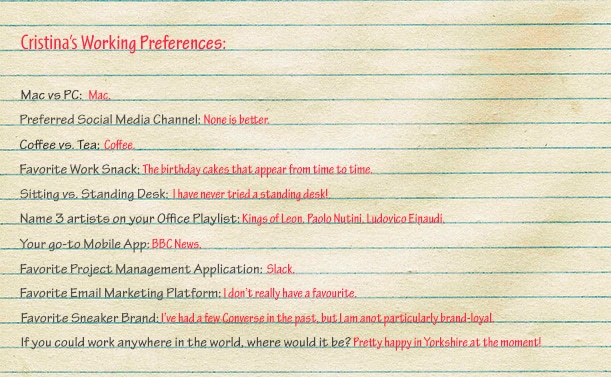
Cristina’s Working Preferences:
Mac vs PC:
Mac
Preferred social media channel:
None is better
Coffee vs. tea:
Coffee
Favorite work snack:
The birthday cakes that appear from time to time
Sitting vs. standing desk:
I have never tried a standing desk!
Name 3 artists on your office playlist:
Kings of Leon, Paolo Nutini, Ludovico Einaudi
Your go-to mobile app:
BBC News
Favorite project management application:
Slack
Favorite email marketing platform:
I don't really have a favorite
Favorite sneaker brand:
I've had a few Converse in the past, but I am not particularly brand-loyal
If you could work anywhere in the world, where would it be?:
Pretty happy in Yorkshire at the moment!
Agency to watch

Best in Breed since 1998. Lounge Lizard is a Digital Agency that Specializes in Brand Strategy, Website Design, Web Development, Mobile APP Development, Online Marketing, Social Media, Ecommerce, and SEOdigital experiences that move brands and businesses from now to next.
Featured agencies

135035 Views

115587 Views

109356 Views

91837 Views

88316 Views

83114 Views

74740 Views

61546 Views