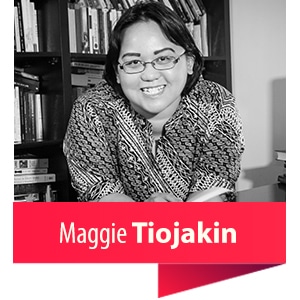
Maggie Tiojakin: “We don’t tell stories, we build them”
Maggie Tiojakin: “We don’t tell stories, we build them”
 Jakarta, February 24th, 2022
Maggie Tiojakin is a writer, translator, editor, creative writing instructor, business communication consultant, as well as Co-Founder and Chief Creative Officer at B/NDL Studios. The agency focuses on storytelling and provices a wide range of creative services based on the principles of how to build great stories.
In an interview with TIA, Tiojakin described her first steps in the digital industry and what life is in Jakarta, where she lives with her family. She highlighted how B/NDL Studios is capable of building the story of brands and described what are the main components of a story, which should always include a conflict and its resolution.
To kick things off please can you describe to us a little bit about Jakarta and why it is a great place to work? What’s one must-do experience in your opinion?
Jakarta is the capital city of Indonesia and is best described as a city of contradictions, which is part of its beauty. Its daytime population (18-20 million) almost doubles that of its nighttime population (10-12 million), because during the day people who live in suburban areas around the city come to work in the city. This gives the city a unique blend of urban-suburban social structures, and you can see this from the different types of social spaces. It’s Melbourne meets New York meets Manila, with more than enough sprinkles of unpredictability.
It’s a great place to work for people who are looking to build and innovate, primarily because Jakarta is also a city driven to be better. Its aspiration to be a self-sustaining city with great values is often held back by the same challenges faced by developing countries (infrastructure issues, convoluted legal system, political instability, etc). However, it also means there’s lots of rooms for improvement — and this provides incredible opportunities for people and organizations to fill in the gap. The exponential growth of start-ups and its business ecosystem is one indication of such opportunity.
I don’t think Jakarta is ever going to be the next New York, London or Shanghai; but I do believe Jakarta is going to be bigger and better.
A must-do experience in Jakarta is to find its legendary eateries and restaurants that serve local dishes and experience the city’s cultural melting pot through its food. Also, people always hate the fact that Jakarta is full of malls — but I think these malls can give you quite an experience.
How did you first become interested in digital experiences?
Since early 2000s when major media outlets began to shift their news distribution strategy from print to digital. In the year 2000, I interned at The Atlantic just as it was building its digital presence (which we now recognize as theatlantic.com) and at the time the division was known as “new media”. This was 20 years ago. New media has now become the media of choice — and at the rate we are going I can’t imagine what the next 20 years is going to bring. Beyond that, I have a huge and undying love for video games — and the evolution of video games in the digital age is truly inspiring, if not mind-blowing.
The pandemic, in particular, has accelerated some of these digital experiences in a way that would have taken decades. Now, more than ever before, nearly all 7.9 billion of us in this world are digitally connected to each other. What this means for us — as a storytelling agency — is how to help brands and organizations strengthen that connection through stories that work.
Working with the right agency can be a valuable partnership. What attributes do you want people to associate your B/NDL Studios with?
We don’t tell stories, we build them. Unlike most agencies, we don’t chase the numbers — followers, traffic, impressions, etc. We chase meaning — the closer we can help our clients build the story they can see themselves in, or which they can resonate with, this is our measure of success. We help our clients identify their own story assets, and then we build their story.
How can leadership create and then cultivate an inclusive workplace?
Leadership is about setting examples. Whether you set good or bad examples, it is likely your team will follow in those footsteps. We all lead by example whether we mean to or not. A toxic working environment almost always begins with toxic leadership examples; and the opposite is equally true. Therefore, anyone in a leadership position should keep this in mind at all times. What you do sets the tone for everyone on your team — so, if you want to create an inclusive workplace, you should start with yourself. Show the team how it’s done. Remind them why it’s important. And be consistent. Never expect your team to do what you are not willing to do yourself.

Tell us about a recent project you’ve worked on that you’re proud of. What particularly brought out the best in you?
We worked on a project for a global non-profit organization where we had to build a content strategy that best addresses their mission to bring together island nations around the world, and tackle climate change issues. We’re particularly proud of this project because we nailed the issues head-on and we built a story that works not only for our client, but also for their stakeholders. It was also one of our major projects during the early days of the pandemic; and the project sort of became the highlight of the year as we all came together for a shared purpose under such difficult constraints what with global lockdowns and slowing economy.
The perfect client brief: Does it exist? What recommendations would you give to clients to help streamline the process between their vision and your process?
We all know that when it comes to client briefs, communication is key. This is nothing new. This is what all agencies do. We communicate. But most people don’t listen, or they don’t ask the right questions. At B/NDL Studios, we thrive on being good listeners and on asking the right questions. This is our way of communicating with our clients. We listen. We ask the right questions. We’re relentless when it comes to building the most effective brief. Not perfect, but effective. There’s also a kind of obsession around building an effective brief. In terms of process — every client is different and every situation is unique. Sometimes we meet them halfway; other times, we go the extra mile. That’s just the way it is.
We are living through the most important pandemic in recent world history. What’s the most stimulating part of working in digital at the moment?
I regret and continue to feel anxious about what the pandemic has done and is doing to our collective health and welfare as a global community, but I do love how the pandemic has forced us to consider and reconsider all possibilities, even the ones we didn’t know were possible. We continue to discover something new with each challenge we undertake — most of the time, such discovery makes us better people. Better communities.
With shopper behaviour changing, what impact do you believe machine learning and big data will have on the world of creative production?
I believe creativity has always been about connecting with people on a deeper and more personal level. I’m excited about what machine learning and big data can and will bring to the creative table, especially to help us better understand our audience. The better we can understand our audience, the greater the value of experience we can build for them. And this is what connection has always been about. The value of an experience.
Connecting with an audience has never been more challenging for businesses. What are the key components of a good story?
The list is endless. For us, though, there is one major component. A story is good when it has to overcome a real conflict. Most brands are afraid of addressing the conflict in their story, which by default actually turns their story into a non-story. You can’t run a story without a conflict. It’s not interesting. No one’s going to buy it. And by conflict, I don’t mean hardships. I meant the way we see the world. Our principles and perception. Our ideologies and beliefs. Conflict isn’t a bad thing; nor a good thing. Conflict is conflict. It’s a part of us. We are all shaped by conflicts. It has a bad reputation because we put a negative context to it. Conflict is fire. Conflicts are the cracks in our emotional wall. But it doesn’t have to be any of those things. We can work with conflict and sharpen our message. I know it’s scary, but if you want to use story, you’ve got to bring the conflict. Be strategic about it. Choose the one that can best amplify your stance or values. Life is full of conflicts. Your audience lives this truth every day. This is the only way they can connect with your story. Give them a conflict they can vouch for. And show them they’re not alone.
What tips do you have for brands trying to define their brand voice on Social Media?
The best way to determine your brand voice is to understand your brand, inside and out. This is more complicated than it seems. We’ve worked with clients who believed they know and understand their brand, but then also said, “Make us look like that other brand.” Understand your brand — not what you want your brand to be. Identify your brand truth. Find your voice after you have made the identification. Be genuine.
Three top digital tools you can’t live without?
Discord, WhatsApp, emails.
Ambition or talent: which matters more to success?
Neither of them, actually. Ambition in a person can mean blind desire, and I’m not wild about working with ambitious people who are willing to sacrifice their own value (or the value of others) in order to succeed — so I don’t seek ambition when recruiting a team member. Tenacity, perseverance and the willingness to learn are three things I always look for in a team member. Age, educational background and experience don’t matter as much. And as for talent, I have to say this: talent is cheap. The world is full of unsuccessful, talented people. Talent gives you 1% advantage for success. The rest is hard work and perseverance. I would never, ever bank on talent.
What advice do you have for women aiming for leadership positions?
Men are not the enemy. Women are not the enemy. The world is run by a flawed system — this is the true enemy. Sure, there are men who put women down; but there are also women who do the same thing. So, it’s not gender as much as a mindset rooted in a flawed system. If you wish to thrive as a leader, you can’t ever play the victim card. Step up and aim to change the system. Don’t seek to be a hero. Seek to be a change agent. Lead with conviction, but be open to change. Speak your mind, even if it’s hard. If people can’t or won’t appreciate your ideas, or contributions, it’s their loss — not yours. Move on.
Which unusual skill do you pride yourself in having?
I studied liberal arts and, for most of my adult life, I focused on building a career as a journalist, then a fiction writer. This is to say, I’m very good at reading people to a point where I was often mistaken for a clairvoyant. I’m not a clairvoyant. That’s crazy talk. It’s just that I was trained to be very very good at observing and analyzing human behavior.
You are a big fan of Woody Allen, aren’t you? If he joined you for dinner, what would you ask him?
Ha. Yes, I am. I don’t support his personal behavior, obviously; and I understand in this woke culture you’re not supposed to like Allen’s work because of all the controversial issues surrounding him — but I do enjoy his earlier work tremendously. Radio Days is my favorite. I don’t enjoy his later work as much. They’re … empty. Imaginative, but eventually empty. Lots of big stars and big surprises. His earlier films didn’t go for the fireworks. They were always small and quirky; some of them were almost insignificant. But I always found myself pleasantly lost in them. There’s something tragic about his approach to comedy that makes it so life-like. So, to answer your question: if he joined me for dinner today, I would ask him about the distance between humor and tragedy — and whether he’s discovered the meaning of life. On another note, though, I would probably prefer to cancel the dinner. For me, to meet the person whose work you admire often takes the magic out of the work itself. I plan to watch Radio Days again and still be able to access its magic.
Maggie’s Working Preferences:
Early Bird or Night Owl?:
Night Owl
Usual breakfast:
Toast
Most quoted book, TV Show or movie:
"You can't handle the truth!" (Jack Nicholson. A Few Good Men)
Last place traveled:
Singapore
Last downloaded app:
Astro and Not A Spelling Bee
Favorite sneaker brand:
New Balance
The game you’re best at:
Pachisi and Reversi
Preferred spot in your town:
Plaza Senayan
What makes a good day at work?:
When I have time or make the time to appreciate the work others are doing
Thanks Maggie!
Follow Maggie on social media:
Follow B/NDL Studios on social media:
Agency to watch

Best in Breed since 1998. Lounge Lizard is a Digital Agency that Specializes in Brand Strategy, Website Design, Web Development, Mobile APP Development, Online Marketing, Social Media, Ecommerce, and SEOdigital experiences that move brands and businesses from now to next.
Featured agencies

135153 Views

115685 Views

109416 Views

91914 Views

88431 Views

83201 Views

74835 Views

61605 Views